














Transforming America’s Alliances PDF Thumbnail

The emerging changes in the geopolitical and military-technical environments will lead America to seek different qualities in its relationships with its allies.  A new division of labor will have to be arrived at that takes into account changes in:  ally durability and reliability; the new missions brought on by the military revolution (e.g., precision strike, space control, strategic information warfare, ballistic and cruise missile defense, power-projection in the absence of fixed forward bases); and the likely shift in principal focus from Europe to Asia.

A number of blue-ribbon defense commissions—the National Defense Panel (NDP) and the Rumsfeld Commission among them—have identified these emerging challenges, both to the US homeland and to the ability of the future American military to project power overseas.  However, the United States’ current defense program, as presented in the Defense Department’s Quadrennial Defense Review (QDR), does not provide the kind of strategic reappraisal of the future security environment that these emerging threats demand.  Rather, the US military continues to place primary emphasis on prevailing in future Desert Storms, unlikely as they are, at the expense of transforming itself to conduct the military operations that will be key to future success.

In short, the long-term challenges facing the United States and its allies appear to be far more serious than those they confront today.  As such, greater priority must be placed on transforming the US military so that it can effectively counter those future threats, even if doing so means accepting some marginal increase in risk over the near term.  Conversely, if the US military is not transformed, it may lack the dominant military capabilities needed to attract and maintain critical allies 10-20 years from now, when the United States will most need them to defend its global security interests.

The preliminary assessment of future US security requirements, and the implications for alliance structures, undertaken in this paper is intended to serve as a point of departure for a more thorough assessment.  However, this paper does offer some preliminary recommendations with respect to the future US alliance structure.  The United States should accord high priority to:

  • Maintaining its existing alliances with core great regional powers—NATO/EU (i.e., France, Germany, and Great Britain) and Japan.  This will likely prove more difficult than during the Cold War, when America and its allies were bound tightly by an immediate, overarching threat.
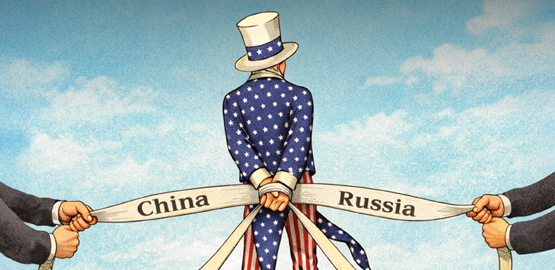
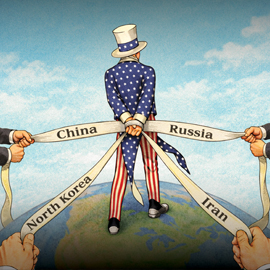
  • Cultivating relationships with the other likely rising or recovering great regional powers—China, India, and Russia—with the objective of avoiding the creation of a counter-US coalition, among some or all of these powers.
  • Maintaining or cultivating relationships with key existing, and potentially rising, second-tier military powers, to include Australia, Israel, Korea, Turkey, and perhaps Singapore and Taiwan.