













An Alternate Plan
Based on the analysis of future tasks and missions for the TFBN, as well as expected future budgets, this paper makes several recommended changes to the Navy’s current plans. These recommendations are shaped by the following assessments:
- The United States need not worry about losing global maritime superiority any time soon. Even with “only” 280 warships, the Navy’s current Total Force Battle Network it still the most powerful naval force in the world by a wide margin. When considering the combined capabilities of the 583-ship National Fleet, as well as the support the Navy’s TFBN receives from the broader Joint Total Force Battle Network, the margin of US naval superiority is even wider.
- The future TFBN should continue to be a two war-plus force, but with a more specific orientation. It must first be large and capable enough to support overlapping joint fights against a large, continental-sized adversary with advanced maritime recon-strike and undersea combat networks, and a mid-sized, nuclear-armed, regional adversary. The future TFBN should also be able to support operations against radical Islamist terrorists and the evolving Joint Global Counterterrorist/Counterproliferation Network, as well as maintain persistent forward presence requirements for both combat-credible forces and proactive maritime security and partnership-building operations.
- Meeting the foregoing warfighting requirements is less about increasing ship numbers, and more about getting the right mix of TFBN capabilities and capacities. Moreover, while creating favorable security conditions and supporting the Joint Global Counterterrorist/Counterproliferation Network may require new thinking about naval forward presence, it will not require a major expansion of ships. The idea is to build partnership maritime capacity in the world’s littorals, not to flood the world’s littorals with US ships.
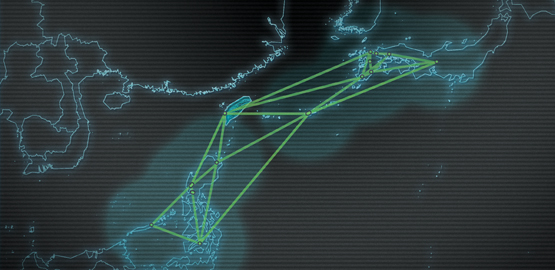
- To support persistent global maritime security operations as well as the Joint Global Counterterrorist/Counterproliferation Network, the Navy will need to establish a minimum of seven Global Fleet Stations in the following regions: Caribbean and East Coast of South America, West Coast of Africa, East Coast of Africa, Southwest/South Asia, Southeast Asia, East Asia, and Western Pacific/Oceania.
- Fighting against advanced multidimensional maritime recon-strike networks and against regional nuclear-armed adversaries will require the future aircraft carrier and surface combatant fleets to operate and fight from greater ranges than they do today.
- Future multidimensional maritime recon-strike networks will likely include increasingly sophisticated undersea combat networks. As a result, the tactical submarine fleet must develop a whole new generation of undersea weapons and capabilities including smaller multipurpose submarines (both manned and unmanned), vehicles and weapons.
- Seabasing is not about replacing land bases. In the context of a two-war standard, seabasing is about exploiting command of the seas to enable the rapid transoceanic expeditionary maneuver of ready-to-fight combat units and the rapid movement of personnel, goods, and services, thereby providing an interdependent joint force with a high degree of global freedom of action and initial operational independence from forward land bases.
- The idea of an integrated and interoperable National Fleet — incorporating the combined capabilities of the Navy, Marine Corps, Coast Guard, Military Sealift Command, and the strategic sealift fleet — is a powerful one that should be realized to the greatest possible degree.
- As a result of its great margin of maritime superiority, the United States can patiently and carefully assess the direction of the long-term global naval competition before making any dramatic changes to its force structure or organization. In the meantime, to strengthen its long-term competitiveness, the US Navy must invest in robust research and development while sustaining the country’s naval design and industrial base. It must also work to reduce both costs for individual ships and projected expenditures for building and sustaining the fleet.
- The four best ways to reduce shipbuilding costs and conserve resources are: exploit ship and aircraft designs now in production to the fullest extent possible in order to benefit from learning curve efficiencies; reduce the total number of different ship types to accrue savings in training, maintenance, and logistics; reduce crew sizes, which are the largest driver of a ship’s life-cycle costs; and aggressively pursue improved networking capabilities.
- Given expected future defense budgets, the levels of resources needed to support the Navy’s current plan are unrealistic. A more plausible total yearly shipbuilding target might be in the vicinity of $20 billion — a 25 percent reduction over the Navy’s plan. Given the uncertainty over future defense budgets, assuming the Navy will receive even $20 billion a year for shipbuilding may be too optimistic.
Based on these assessments, the Navy should consider making the following changes to their current plans. Unless indicated, all costs are expressed in FY 2009 constant dollars.