













The War in Afghanistan in Strategic Context PDF Thumbnail

A Regional Strategy

Afghanistan is not the only major challenge to our security. our response to this challenge must be placed within a broader context, one that also extends beyond Pakistan. Given our current force commitments, Iraq and Iran must figure prominently in any strategic assessment. Clearly, our ability to sustain a major commitment in Afghanistan is dependent upon the continued move toward a stable Iraq. It is desirable to continue the drawdown of our forces in Iraq. However, for the foreseeable future we should try to avoid lowering our force levels there below 30-40,000 troops. There is an old saying regarding the creation of NATo that applies to Iraq, which states: “NATo is being created to keep the Soviets out, the Americans in [i.e., engaged in Europe], and the Germans down [i.e., from upsetting the stability of Europe].” Similarly, a significant and enduring American presence in Iraq is needed to keep the Americans in, the predators out, and the factions down. Only a significant and enduring American military presence offers a strong guarantee that a still-weak Iraq can withstand pressures from predators (e.g., Iran; al Qaeda) and avoid becoming a victim of conflict among its internal factions (i.e., the Sunni Arabs, Shi’ia Arabs and Kurds). A stable Iraq also reduces Iran’s prospects for creating instability in the region.

Needed: An Overarching Strategy Review

Those afflicted with too narrow a perspective on important issues are said to be “unable to see the forest for the trees.” Mr. Chairman, I commend the committee for its efforts to ensure that the Congress does not suffer from strategic myopia. In this regard, a strategy that focuses narrowly on Afghanistan can be seen as focusing not on trees, but rather on acorns, with a near-term regional strategic focus representing the trees.

The view of the “forest” that we risk missing is driven by major and ongoing shifts in our relative economic standing in the world, by unprecedented demographic trends, by technology diffusion and by the increasingly rapid erosion of our near-monopoly over certain key military capabilities.
Simply stated, the military foundation of our global dominance is eroding. For the past several decades, an overwhelming advantage in technology and resources has given our military an unmatched ability to project power worldwide. This has allowed it to guarantee our access to the global commons, assure the safety of the homeland, and underwrite security commitments around the globe. Our grand strategy since 9/11 assumes that such advantages will continue indefinitely. In reality, they are already disappearing.

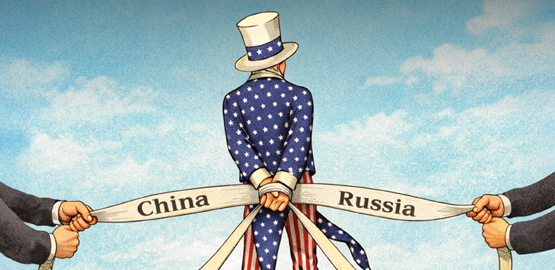
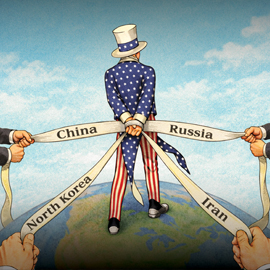
Several events in recent years have demonstrated that our traditional means and methods of projecting power and accessing the global commons are growing increasingly obsolete—becoming “wasting assets” in the language of defense strategists. The diffusion of advanced military technologies, combined with the continued rise of new powers, such as China, and hostile states, such as Iran, are making it progressively more expensive in blood and treasure—perhaps prohibitively expensive—for the American military to carry out its missions in areas of vital interest, including the Western Pacific and the Persian Gulf. Military forces that do deploy will find it increasingly difficult to defend what they have been sent to protect. Meanwhile, our military’s long-unfettered access to the global commons—including space and cyberspace—is being increasingly challenged.

If history is any guide, these trends cannot be undone. Technology inevitably spreads, and no military has ever enjoyed a perpetual monopoly on any capability. We can either adapt to contemporary developments or ignore them at our peril. There is, first of all, a compelling need to develop new ways of creating military advantage in the face of current geopolitical and technological trends. That means taking a hard look at military spending and planning and investing in certain areas of potential advantage while divesting from other assets.

All this must be accomplished in an environment of high budget deficits projected out as far as the eye can see, a skyrocketing national debt, and significantly diminished resources for a host of national priorities, including national defense. Making matters worse, our traditional allies’ fiscal prospects are no better than our own, and, in some instances, substantially worse. We cannot expect more from them; indeed, we are likely to get significantly less.
In short, we confront what is likely to be a more dangerous world but with a diminished capacity to defend ourselves. Before questions about how to adapt military capabilities to future requirements can be considered coherently, there must be a strategic framework. We must develop a comprehensive strategy that addresses a far more formidable set of challenges to our security than that posed by Afghanistan alone. In recent years, whether it be 9/11, Afghanistan or Iraq, we have found ourselves reacting to emerging challenges rather than anticipating them. Ignoring growing challenges to our security will not make those challenges go away. Sooner or later, they will have to be confronted. A decline in our military’s ability to influence events abroad may be inevitable; however, it should not be the result of indifference or lack of attention. There are important strategic choices that the United States must make. To avoid those choices now is simply to allow the United States’ rivals to make them for us.